


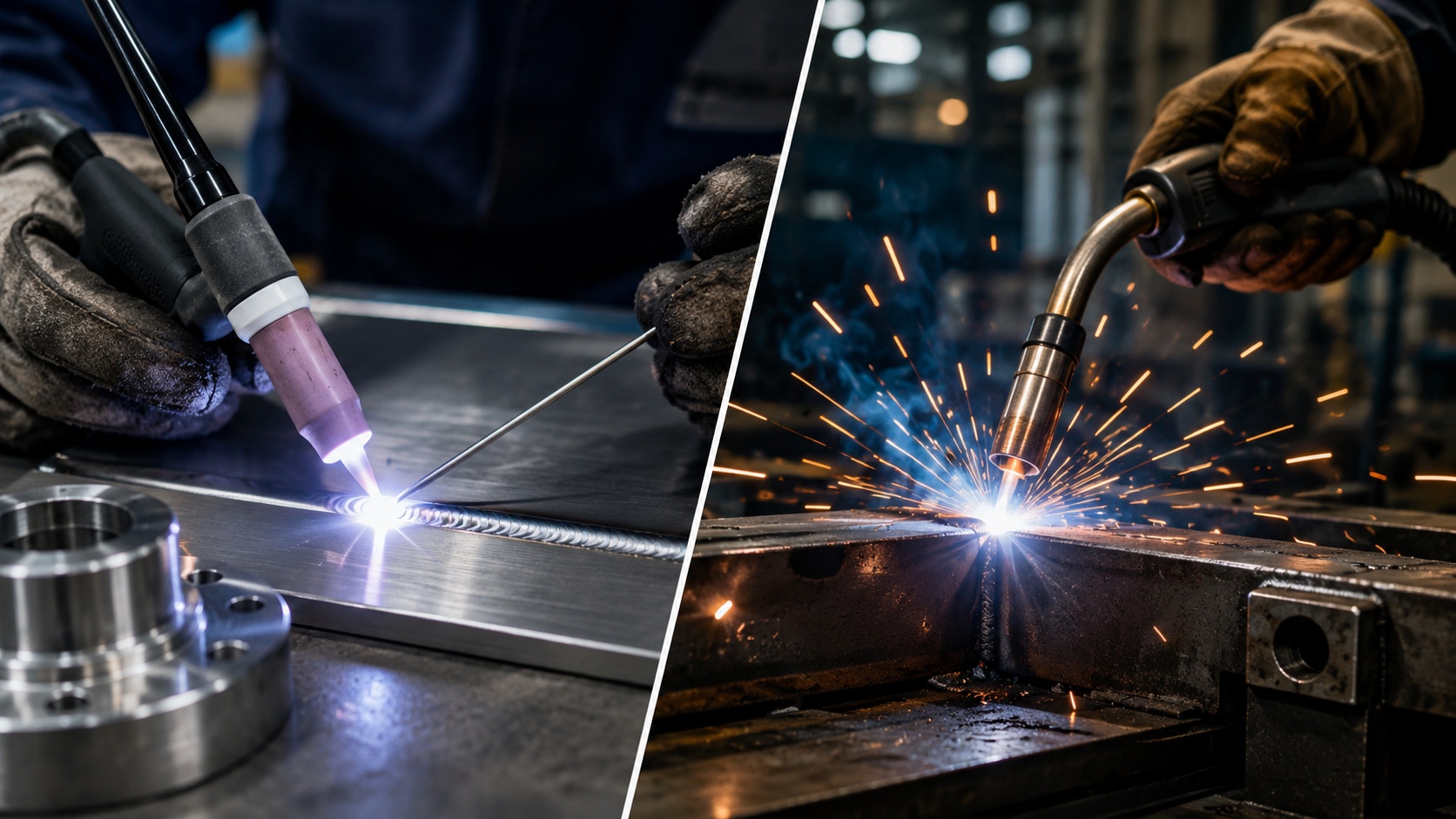
When an industrial company needs to hire a welder, one of the first questions that arises is: what type of welding do we need? And although it may seem like a minor technical detail, the answer has a direct impact on the quality of the work, the timescales and the cost of the project.
In this article, we explain the differences between TIG welding and MIG welding, what each is used for and how to know which profile your company needs.
What is TIG welding?
TIG welding uses a non-consumable tungsten electrode and allows more precise control of the electric arc. Although it is slower and demands greater skill, it offers high-quality finishes.
In practice, this means that the TIG welder works with both hands: one holds the torch whilst the other manually feeds the filler material. It is a technique that demands concentration, precision and years of experience to master.
TIG welding is used above all when quality is sought before speed. It is not the best option when there is urgency to finish a piece, but rather when the joint needs to be impeccable and last for many years.
Where is TIG welding used?
Its common applications include the aeronautical and naval industries, fine boilermaking, stainless steel work and projects with high aesthetic requirements. It is also the preferred technique in the manufacture of medical components, pipework for the food or pharmaceutical industry and metal structures that must withstand great stress.
What is MIG welding?
MIG welding uses a wire that melts continuously and a gas that protects the work. Its great advantage is that it is faster and relatively easier to learn than TIG, making it ideal for mass production and high-volume work.
Unlike TIG, MIG is a continuous process: there are no starts and stops, the wire feeds automatically and the work pace is much more agile. This makes it the most common option in industrial environments where productivity is a priority.
Where is MIG welding used?
Its common applications include the manufacture of metal structures, vehicle bodywork, metal furniture and quick repairs. It is also very common in shipbuilding, the heavy machinery industry and any environment where steel is worked in large volumes.
TIG vs MIG: what is the fundamental difference?
TIG welding achieves a finer, more controlled finish, whilst MIG stands out for its speed and productivity. Put simply:
Choosing the wrong welder is not just a technical problem — it is a real cost: rework, delays and compromised quality. Knowing the difference between TIG and MIG is the first step towards hiring well.
Neither is better than the other in absolute terms. The key lies in knowing which one your project requires.
What welder profile does your company need?
This is the question most frequently asked by the production managers and HR directors we work with. And the answer depends on several factors:
You need a TIG welder if: you work with materials such as stainless steel, aluminium, titanium or special alloys; your sector demands high-quality finishes (aerospace, food, pharmaceutical, naval); projects require specific approvals or technical certifications; precision and joint strength are prioritised over speed.
You need a MIG welder if: you work with carbon steel or large production volumes; your sector is automotive, metal construction or machinery manufacturing; you need to cover production peaks quickly and efficiently; work pace and productivity are the key factors.
In many industrial companies, the answer is not one or the other: profiles from both specialities are needed depending on the type of project or the production phase.
The welder market: a reality to be aware of
Beyond the technical differences, there is a reality that every industrial company must bear in mind: the average salary of a welder in Spain is €21,600 per year, although the most experienced professionals can earn up to €25,475 annually. The most specialised profiles, such as approved TIG welders, are particularly scarce and highly valued in the market.
Finding the right profile independently can be a long and frustrating process. Many companies choose to work with a specialist industrial labour provider that already has a pool of qualified candidates and understands the real demands of the sector.
At MetalBraga, we manage both profiles
At MetalBraga, we have many years of experience supplying TIG, MIG and arc welders to industrial companies throughout Spain. We know the differences between these profiles, we know what certifications are required in each case and we have qualified professionals ready to join when your company needs them.
If you are looking for a specialist welder and do not know where to begin, contact us. We would be delighted to help you find exactly the profile you need!